Reliability observability
Capture unified telemetry across perception, planning, control, and hardware layers to expose reliability signals in real time.
 Continuous Reliability
Monitor fleet health, surface failure patterns, and turn reliability engineering into a live operating layer for robots in the real world.
Built for serious robotics programs
Designed to align with frontier labs, smart manufacturers, and operational robotics teams that require measurable reliability outcomes.
Platform capabilities
A concise view of the operational modules teams use to instrument, diagnose, validate, and improve fleet reliability across changing environments.
Capture unified telemetry across perception, planning, control, and hardware layers to expose reliability signals in real time.
Correlate anomalies with software revisions, operating conditions, and subsystem events to shorten root-cause investigation cycles.
Run repeatable reliability gates for model and firmware changes before deployment across labs, pilots, and production fleets.
Track uptime, incident frequency, and degradation trends across robot cohorts with alerting tuned for operational risk.
See how reliability work translates into clearer day-to-day decisions across robotics validation, deployment, and fleet operations.
Signal
Unifies model, hardware, and mission behavior into one reliability view teams can act on quickly.
Signal
Correlates incident traces, logs, and environment context so root causes are isolated with less guesswork.
Signal
Surfaces unresolved reliability risks before rollout, helping teams promote only stable robot behaviors.
Signal
Keeps reliability posture consistent across labs and production lines even when operating conditions differ.
Use Cases
Three operating contexts, one reliability layer: validate behavior, isolate repeat faults, and improve deployment confidence across AI-driven robotic systems.
Stress-test policies in uncontrolled environments before field pilots scale.
Connect engineering and production signals to improve deployment quality at launch.
Maintain uptime across sites with fast diagnosis and consistent fleet oversight.
Platform Architecture
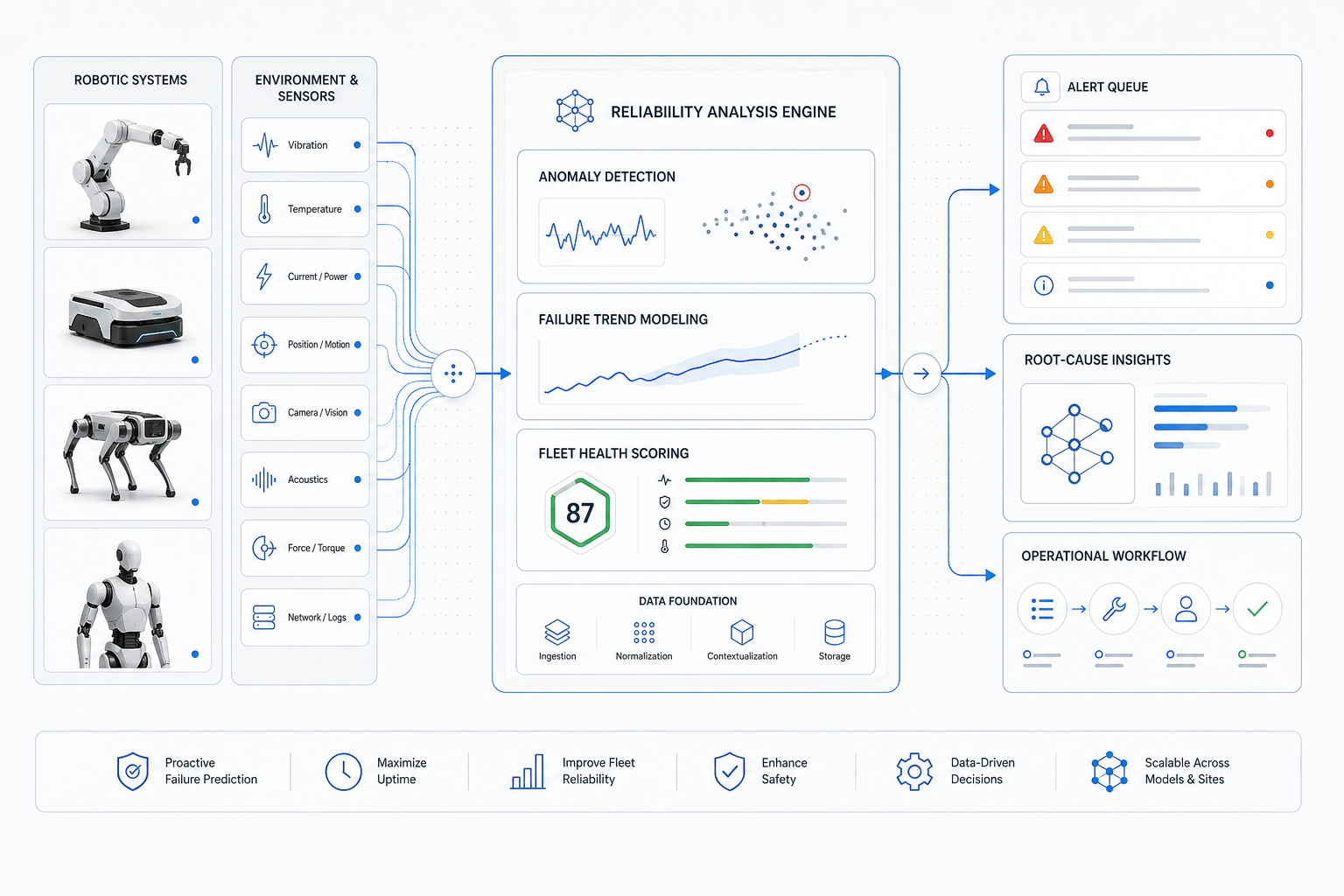
From telemetry ingestion to operator action, each layer is built for production fleets across labs and manufacturing cells.
Collect robot state, sensor streams, controller logs, and environment context into one normalized reliability timeline.
Correlate anomalies, model failure modes, and score fleet health by robot type, workload, and operating condition.
Deliver prioritized alerts, root-cause traces, and validation tasks directly to reliability, safety, and operations teams.
Industry Voices
Teams responsible for uptime and model behavior rely on structured reliability signals to diagnose faster, validate safer releases, and keep fleets stable across environments.
“We moved from incident guessing to traceable failure chains. Our reliability reviews now start with evidence, not assumptions.”
“Cross-model observability cut diagnosis time during field regressions. Ops and ML teams now resolve root causes in the same shift.”
“Release validation became auditable across sites. We deploy with clearer risk boundaries and fewer repeat faults in production.”
Evaluation FAQ
Direct answers to the most common reliability-platform evaluation questions from robotics labs and industrial automation teams.
Need deeper architecture or data-path specifics? We can walk through your stack and define a concrete pilot scope in one session.
Book a demo.